AI · Travel
I designed an AI travel agent that plans your entire trip — down to which api books the flight
Trip planning is broken. Wander doesn't help you research a trip — it prepares the whole journey for you.
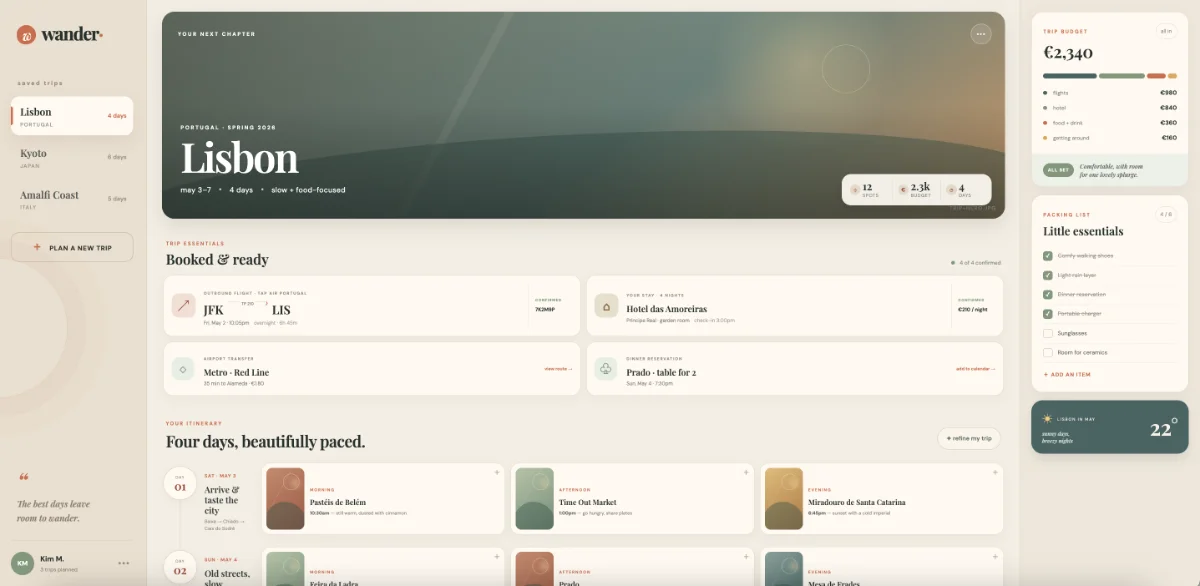
trip planning is broken. You open 23 tabs, compare flights that expire while you're looking at hotels, guess whether two attractions are actually near each other, and after six hours you have a spreadsheet — not a trip. We accepted this as normal. It's not normal, it's only old. So I designed Wander: an AI travel planner that prepares the whole journey for you.
What Wander does
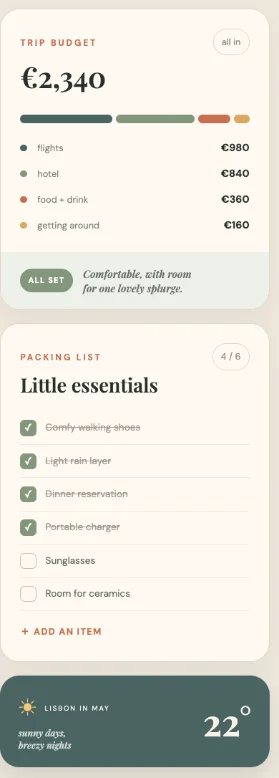
You tell it one sentence: "four slow, food-focused days in Lisbon, boutique hotels, no rushed mornings." That's it. Wander turns that into structured preferences — budget, pace, food style, accessibility, even what time you like to start your day — and then builds the entire trip: live flight options, hotels that match your vibe and budget, airport transfers, restaurant reservations, attractions, optimized daily routes, weather-aware scheduling, a full trip budget, and calendar events waiting in your phone.
The key word is coherent. This isn't a chatbot handing you a list of "top 10 things to do in Lisbon." It's a digital travel designer that makes every piece work with every other piece.
Under the hood
The blueprint: Next.js, React, and TypeScript for the app. The OpenAI api as the brain — using structured outputs and function calling, so the model returns reliable itinerary data instead of free-form text. Amadeus for flights and hotels, Google places and routes for the map intelligence, a weather api for scheduling, stripe for payments, postgresql for trips and bookings, redis and background workers for price refreshes and long planning jobs.
I'm not a developer. But I can architect a product like this end to end — which apis, in what order, scoring on which criteria, where the AI decides and where it only verifies. That's the skill AI actually rewards: knowing exactly what to build and how the pieces think together.
Why I'm sharing the blueprint
Because this is what "working with AI" really looks like in 2026 — not asking a chatbot for recommendations, but orchestrating live data, real bookings, and personal taste into one product. And because I want you to see that designing something like this doesn't require an engineering degree. It requires curiosity, product thinking, and the willingness to learn how these tools connect.